






One of the things we’ve learned after nearly a decade of working with veterans is that no two stories are the same. The military has a way of bringing together people from every background imaginable, but when service ends, everyone is left with a similar challenge: figuring out who they are and what comes next.
Some veterans leave the military and immediately find a new mission. Others spend years searching for purpose. Some battle visible wounds. Others carry struggles that nobody around them can see. Many wrestle with identity, trying to understand who they are outside of the uniform and what kind of life they want to build moving forward.
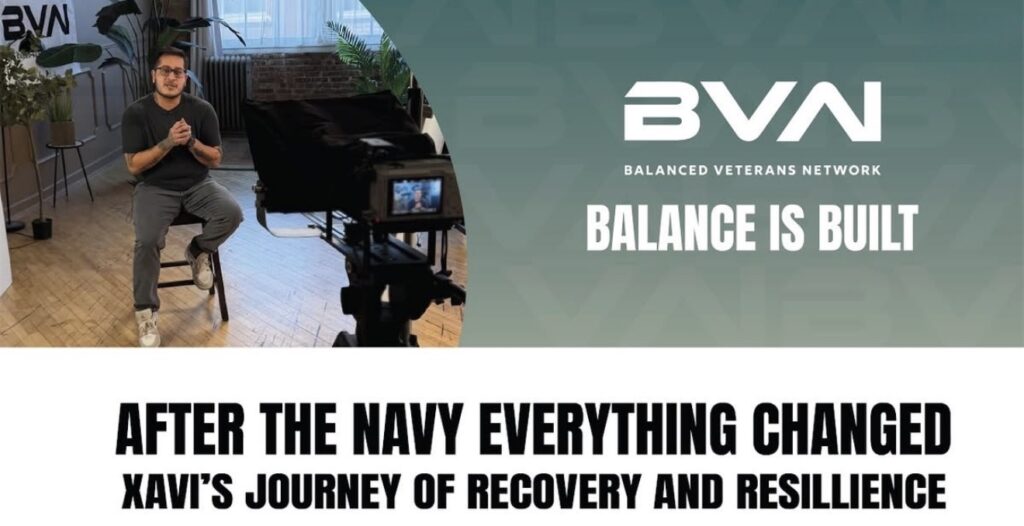
That’s one of the reasons we created the Balance Is Built series at Balanced Veterans Network. We wanted to highlight real veterans having honest conversations about life after service. Not polished success stories. Not social media highlight reels. Just real people talking about the challenges they’ve faced, the lessons they’ve learned, and the work they’ve done to build meaningful lives.
Our latest conversation is with Xavi Vasquez, and while many people will initially focus on the fact that Xavi transitioned from female to male, that is only one chapter of a much larger story.
At its core, this is a story about identity, authenticity, courage, and what happens when someone decides they can no longer live according to other people’s expectations.
One of the themes that kept coming up during our conversation was the idea of carrying a version of yourself that doesn’t quite fit. While Xavi’s experience is unique to him, the underlying feeling is something many veterans understand. The military teaches us to adapt, to perform, to meet expectations, and to push through discomfort. Those skills can be incredibly valuable during service, but sometimes they also teach us how to suppress parts of ourselves. We learn to compartmentalize. We learn to hide struggles. We learn to keep moving regardless of what’s happening internally.
For some veterans, that looks like unaddressed trauma. For others, it’s depression, anxiety, grief, or a loss of purpose. For Xavi, it meant living with an ongoing disconnect between how the world perceived him and how he understood himself. Carrying that weight for years takes a toll, and eventually there comes a point where continuing to hide becomes more painful than facing the uncertainty of change.
What stood out most about Xavi’s story wasn’t the transition itself. It was the willingness to be honest. Honest with himself. Honest about his fears. Honest about the uncertainty that comes with making major life decisions. That level of honesty is something many people spend years avoiding because it’s uncomfortable. It’s easier to stay where we are, even when we know something isn’t working. It’s easier to continue living inside familiar patterns than it is to step into the unknown.
Yet growth almost always requires us to move through uncertainty.
That’s true whether you’re changing careers, ending a toxic relationship, addressing trauma, getting sober, improving your health, starting a business, or redefining your identity. The details may be different, but the process is remarkably similar. Growth asks us to let go of who we’ve been so we can become who we’re capable of being.
Throughout the conversation, Xavi spoke openly about the challenges of navigating that process while also existing within veteran spaces, family dynamics, and society as a whole. Those experiences weren’t always easy. There were difficult conversations, moments of doubt, and obstacles that required persistence and resilience. But what emerged on the other side was something many people are ultimately searching for: the ability to live authentically and stop carrying the burden of pretending.
That lesson extends far beyond any single community or identity group.
One of the biggest struggles we see among veterans is the tendency to wear masks. Sometimes those masks are built from pride. Sometimes they’re built from fear. Sometimes they’re built from years of military conditioning that taught us vulnerability was dangerous. Whatever form they take, those masks often prevent people from getting help, having honest conversations, or acknowledging what they’re actually feeling.
The reality is that healing starts with honesty.
Not honesty with social media. Not honesty with strangers.
Honesty with yourself.
You can’t solve a problem you’re unwilling to acknowledge. You can’t heal from something you refuse to confront. You can’t build a meaningful future while continuously running from who you are.
That truth showed up repeatedly throughout Xavi’s journey.
Another theme that resonated deeply was the idea that wellness isn’t a destination. So many people think there’s some magical point where life finally becomes easy. They imagine a future where all the questions have answers, all the struggles disappear, and everything suddenly makes sense. Life doesn’t really work that way. Wellness is an ongoing process of learning, adapting, growing, and continuing to show up for yourself.
At Balanced Veterans Network, we talk about this concept all the time because it’s the foundation of what we believe. Balance isn’t something you find. It’s something you build. It’s built through daily choices, difficult conversations, healthy habits, meaningful relationships, and a willingness to keep growing even when growth feels uncomfortable.
For some veterans, building balance means focusing on physical fitness. For others, it means improving mental health, reconnecting with family, pursuing education, exploring spirituality, finding purpose through service, or simply learning how to enjoy life again. There is no single blueprint because every person’s journey is different.
What matters is continuing to move forward.
Listening to Xavi’s story serves as a reminder that courage doesn’t always look the way people expect it to. Sometimes courage looks like stepping onto a battlefield. Sometimes it looks like asking for help. Sometimes it looks like admitting you’re struggling. Sometimes it looks like walking away from something that no longer serves you. And sometimes it looks like embracing who you truly are despite knowing not everyone will understand.
Those moments require strength.
Not the kind of strength measured in physical performance or toughness, but the kind that comes from self-awareness and authenticity.
What we appreciate most about Xavi’s story is that it invites people to think beyond labels and assumptions. It encourages us to look at the shared human experience underneath all of our differences. Every veteran knows what it’s like to face uncertainty. Every veteran knows what it’s like to question their identity after service. Every veteran knows what it’s like to struggle, adapt, and keep moving forward despite obstacles.
That’s why stories like this matter.
Not because everyone will share the same experiences, but because everyone can learn something from them.
At the end of the day, this isn’t just a story about transition. It’s a story about becoming. It’s about having the courage to stop living according to someone else’s definition of who you should be and starting the lifelong process of becoming who you actually are.
That’s what Balance Is Built is all about.
Real veterans.
Real stories.
Real growth.
Because life after service isn’t about returning to who you were before.
It’s about continuing to evolve into who you’re meant to become.
thanks for letting me share 🙂